NASA ROVERS — CHECKED MISSIONS
Mars
Mars is the fourth planet from the Sun. Two NASA rovers are still driving there, and several spacecraft watch it from space.
Press and drag to explore
NASA · checked on 26/07/2026
MARS MISSION · AGES 9+
Why is Mars red?
Mars has lots of iron in its soil. The iron reacted with oxygen and made rust-coloured dust. Martian winds spread that dust over almost the whole planet.
It’s like…
Mars is red for the same reason an old iron bicycle can become rusty.
3 ideas to remember
- 1
Mars is a rocky, cold and desert-like planet.
- 2
Its colour mostly comes from rusty dust.
- 3
Robots explore it before a possible human journey.
RoverA wheeled robot sent to explore another world.
AtmosphereThe layer of gas around a planet.
I want to go further
Mars has a very thin atmosphere made mostly of carbon dioxide. It has water ice, but no evidence of life living there today has been found.
Your challenge
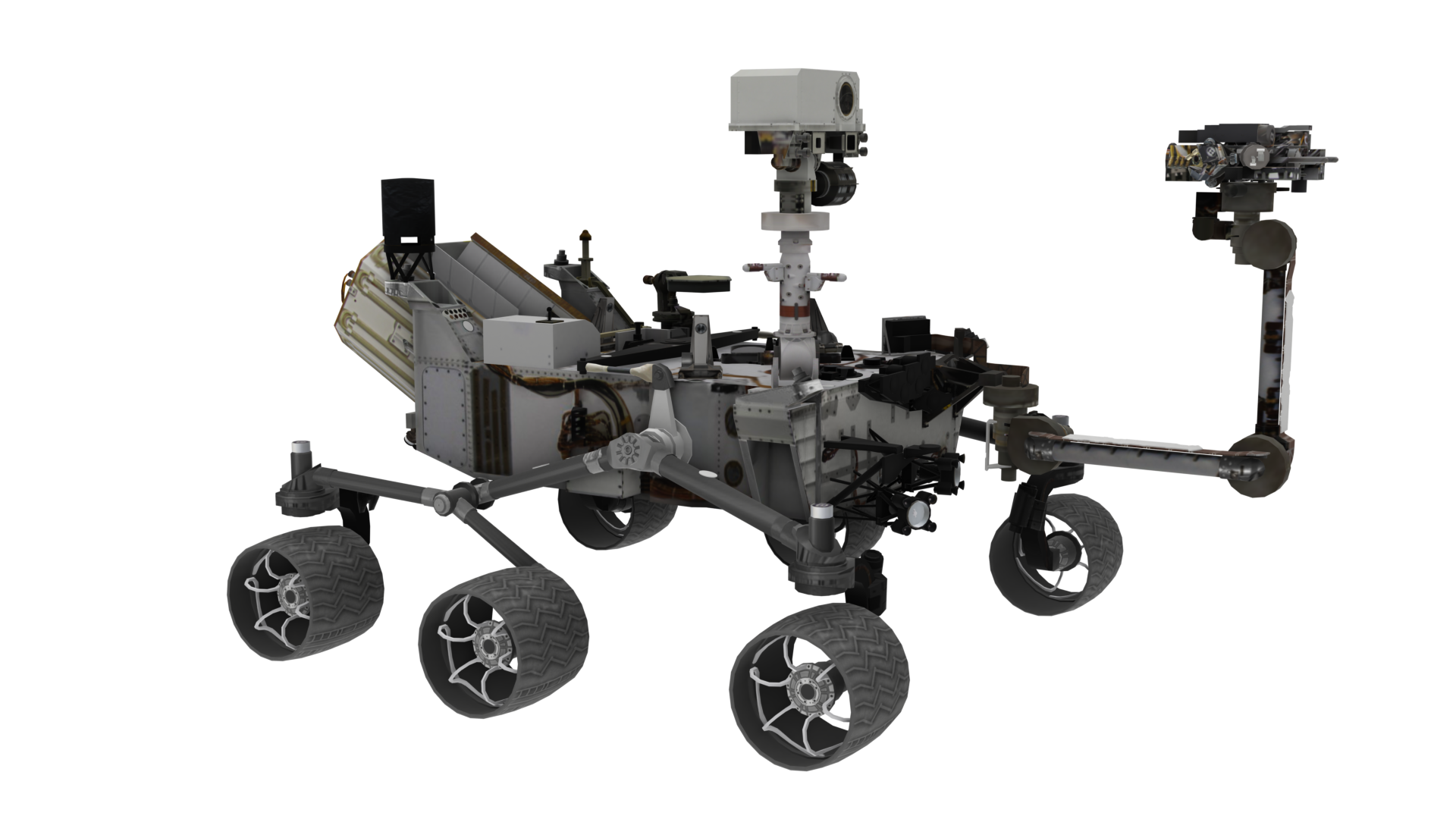
Look at a rover. Can you find the tools it uses to see, drive and study rocks?
5-minute mission
- Read the big question.
- Try one action or comparison.
- Tell someone one thing you discovered.
Answer two questions about the lesson to stamp your passport.
Question 1 of 2
Why is Mars red?
ROVER MISSION · 4 MIN
Help a rover investigate the ancient water of Mars.
Choose your teammate, find its goal, then solve a scientist’s question.
1 rover · 1 clue · 1 answer
- 1. Its goal
Read the layers of rock to find out whether Mars could once have been habitable.
- 2. Its clue
Open the clue when you are ready.
- 3. Your challenge
Look in its fact file for an instrument that helps study rocks.
MARS AT A GLANCE
NASA reference dataMars in eight numbers
Reference data and mission status checked on 26 July 2026: this is not live tracking. See the NASA fact sheet
Rover Curiosity
Mission ongoing · Gale Crater / Mount Sharp · checked on 26/07/2026
A mobile laboratory the size of a car. It has explored Gale Crater since 2012 and is climbing Mount Sharp. It showed that Mars could once have been habitable.
✓ Habitable conditions in the past✓ Organic molecules detected✓ Complex organic matter analysed✓ Continuous radiation measurements✓ Seasonal changes in methane
Launch
26 Nov 2011
Landing
6 Aug 2012
Mass
899 kg
Distance driven
more than 37 km
Time active
sol 4,955 (Jul 2026)
NASA view — Curiosity
NASA/JPL image of Curiosity: it cannot be turned like a 3D model.
Gallery: memorable pictures of Mars
A selection of photos from Curiosity, Opportunity and Perseverance
The NASA rovers shown here
These five NASA rovers tell the story of Mars exploration. Curiosity and Perseverance are ongoing missions; their status is dated above.
The history of Mars exploration
USA
1965Mariner 4 — first flyby
First close-up photos: a surface covered in craters, with no canals and no visible life.
USA
1971Mariner 9 — first orbiter
A full map of Mars. Olympus Mons and Valles Marineris discovered.
USA
1976Viking 1 and 2 — landings
First colour photos from the ground. Biology tests: unclear results.
USA
1997Pathfinder and Sojourner
First rover. Clues of ancient liquid water.
USA
2004Spirit and Opportunity
Spirit finds silica; Opportunity finds small hematite “blueberries”, evidence of water.
USA
2008Phoenix — near the North Pole
First direct detection of water ice just under the surface.
USA
2012Curiosity — Gale Crater
A complete laboratory. Ancient habitable conditions confirmed. Methane detected.
USA
2021Perseverance and Ingenuity
First helicopter on another planet. Oxygen produced. Samples collected.
UAE
2021Hope probe — orbiter
The first orbiter from the United Arab Emirates. It studies Martian weather.
CHN
2021Tianwen-1 and Zhurong
China’s first complete mission: orbiter, lander and rover.
2026Mars Sample Return
NASA is still studying several options to bring the samples back. The schedule is not confirmed.
Did you know?
Olympus Mons is about 2.5 times taller than Everest, and so wide you could not see its edge from the top.
Valles Marineris is about 4,000 km long: almost as wide as the United States.
The air on Mars is so thin that the pressure on the ground is like the pressure 35 km above Earth.
Temperatures range from about -140 °C at the poles in winter to +20 °C at the equator in summer.
Orbiters have found clues that a large ocean may have covered part of Mars billions of years ago.
Its red colour comes from iron oxide (rust) in its dust: Mars really is rusty!